Your clients cannot wait to preview their wedding gallery. They expect to see all their photos in two to three weeks, and every image to look consistent.
Right now, your inbox is full. You are pricing jobs, designing albums, and taking client calls. You have to cull, edit, and post photos. You run a whole business. Soon, you spend more time editing than shooting.
The best wedding photographers build smart systems. They grow their business with a better way to edit. This lets them shoot more, deliver faster, and keep their style perfect. This system is the backbone of your creativity.
Forget all-manual or all-AI editing. The hybrid approach is the new standard. In this simple guide, you will see how this hybrid workflow works. You will learn why it matters and how to start using it without tearing down your old process.
Post-Production: Where Time Goes Hiding
The demand for fast, creative, and consistent galleries is growing to manage workload.
One wedding alone leaves you with 800 to 2,000 images. Editing takes 12 to 25 hours per wedding. Four weddings a month means over 100 hours just for editing. You still need to answer emails and handle business tasks. What you need is AI-assisted post-production to save your time.
Every hour you spend editing is an hour you’re not shooting, not selling, not planning, and not growing your business. If time is money, post-production is the leak in your vault.
Inside the Hybrid Workflow: How AI and Humans Split the Work
Using AI wedding photo editing, along with the human-in-the-loop, can be incredibly powerful for wedding photographers. While AI handles the bulk of repetitive tasks, the human editing team takes care of the brand, style, and emotion.
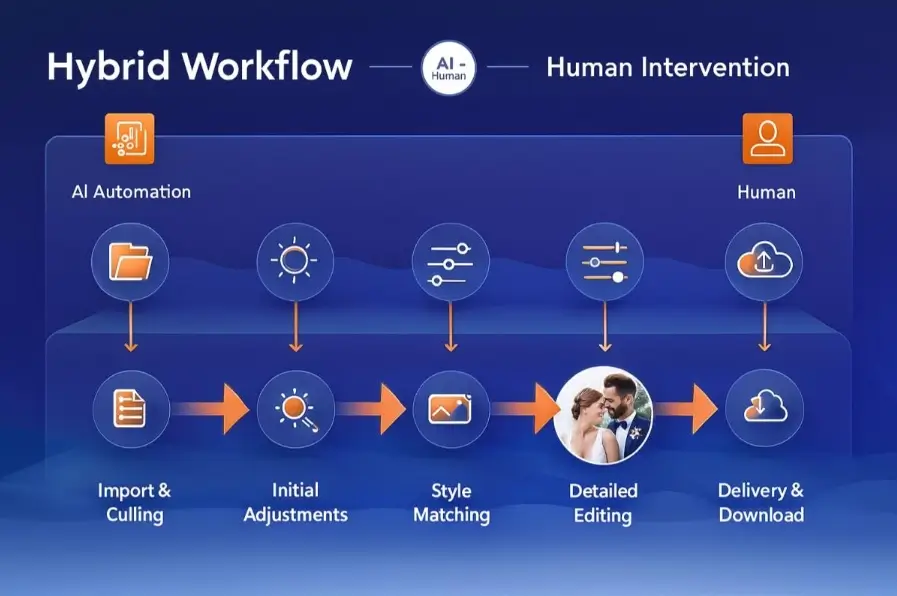
Here’s how the stages of this workflow can be broken down:
| Stage | Handled by | Why this matters |
|---|---|---|
| Import and Culling | AI | Quickly removes duplicates and poor frames |
| Global adjustments (WB, Tone, Exposure) | AI | Brings consistency and helps human editors start afresh |
| Style matching and color harmony | Human | Maintains your brand identity and aesthetic |
| Skin retouching, cleanup | Human | Keeps portraits natural and consistent across different lighting setups and environments |
| Final QA and export | Hybrid | Ensures technical and creative checks before the final delivery |
In other words, AI sets the stage, humans shape the story.
How to Build This Workflow Step-by-Step
Think of the hybrid workflow as an engine. You set up the basic parts once. Then your back end runs smoothly. Your edits stay consistent. You deliver photos faster without trying harder.
Step 1: Fix your style
Make a simple style guide. It must cover your color palette. It must show the mood. Write down how you handle skin tones and retouching limits. This is the playbook. It works for your AI tools and your human editors. The clearer you write it, the more consistent your photo galleries will be.
Step 2: Let AI cull first
Use AI or a separate service to sort the photos. It cuts down the pile fast. This saves you hours. You stop wasting time reviewing frames that look almost the same.
Step 3: Run AI for batch edits
Fix exposure, white balance, and tone in bulk. Do it all at once. This gives every photo the same starting point. Now the creative work can begin.
Step 4: Give the finish to people
This is where your partner helps. SmartPHOTOeditors, for example, handles the color. They balance the tones, do perfect skin retouching for weddings, whiten teeth, remove stray hair, and clean backgrounds. They also crop the images. They fix what AI cannot do. They match your signature style closely.
Step 5: Check the quality
Review a small group of final photos. Check them against your style guide. Make sure the whole gallery looks right. Check it across different lights and different scenes.
Step 6: Automate delivery
Use templates for everything. File names, folder setup, client gallery uploads, and follow-up emails. The more you automate this part, the less time you lose to simple office tasks.
Real-world case study
A wedding studio in the UK was shooting two to three weddings a month and drowning in post-production. They didn’t have a dedicated editor, culling took forever, and every busy season ended with late nights, missed weekends, and a growing queue of images waiting to be processed.
Solution: They partnered with SmartPHOTOeditors, the wedding video post-production experts who helped them build a small team trained specifically in the studio’s style and workflow.
Result: Editing expenses dropped by 50%, and delivery times improved. For the first time in years, the studio had enough breathing room to take on more bookings instead of turning them away.
Why AI alone falls short
The obvious advantage of outsourcing AI wedding photo editing services is getting more time for shooting and handling everything else involved in running a business. But the con can be losing some control over the final product.
While AI editing tools are improving, they are bound to fail without sufficient human oversight. If you completely rely on AI wedding photo editing, you might face common issues like:
- Skin tone shifts across mixed lighting
- Over-smoothed, posterized, or artificial looking reception shots
- Lack of emotional priority in the images
- Diluted brand and style consistency
This is where a strong hybrid partner solves the dilemma. You get the speed and efficiency of AI, but with human editors who protect your style, fix what automation misses, and keep your work consistent from one wedding to the next.
Why SmartPHOTOeditors is the ideal hybrid partner
Finding the right editing partner is as key as building the system itself.
You need a partner who can handle the volume of photos. They must protect your look and give you fast-turnaround wedding edits. This lets you focus on growing your creative wedding business. SmartPHOTOeditors (SPE) gives you:
- Over 200 professional editors around the world.
- AI editing tools with a human artistic finish.
- Expertise in color correction, removing backgrounds, retouching skin, and creating photo montages. We can process huge batches of photos while maintaining your brand’s aesthetics.
We have delivered more than 17 million images and finished over 1,000 projects for weddings and other photography clients. With our setup, you can keep shooting and keep growing. Your editing engine runs smoothly in the background.
We also offer white-label delivery. This means your client only sees your name. They never see the editing partner.
Wedding photo editing tips and ideas
Here are simple wedding photo editing ideas and tips to boost your hybrid workflow:
- Make a mood board: Build a small board with images. Show the colors you like. Show your preferred tone. Show how you handle skin. This becomes the main rule for anyone who works on your photos.
- Let AI cull first: One of the best ways to save time and cost on processing large volumes of photos is to let AI handle the first pass. This way, you only work on the images that deserve your time, rather than manually picking photos.
- Give clear rules: Write clear rules for editing and retouching. This stops confusion. It removes all the guesswork.
- Check the lighting: Look at photos taken in different light. Make sure the mood stays the same in all of them.
- Use simple names: Use structured file naming. Add dates and tags like ‘Raw,’ ‘Edited,’ or ‘Final.’ This lets you track your work fast.
- Set client expectations: Tell your clients the plan early. This stops conflicts and issues later.
- Track your numbers: Watch the important numbers. How fast do you deliver? How many hours did you save? How fast do you reply to emails? How many referrals do you get?
These small changes add up fast. They help you keep your edits clean, consistent, and creative.]
Final Thoughts
How you handle editing determines delivery speed, consistency of your work, and the time you gain back for yourself. By outsourcing wedding photo editing and adopting a hybrid approach, you can make your work faster, more consistent, and scalable. Reach out to SmartPHOTOeditors to know how your clients can get their wedding galleries sooner while you grow your brand.
FAQ’s
What is a hybrid-AI editing workflow, and how does it work for wedding photography?
A hybrid workflow combines AI editing with human creativity. Think of it as a split process. AI does the boring, slow parts of the job. Then, human editors refine the images. They match your art and your look. You gain speed. You do not lose your personal touch.
How much time-saving can AI bring to wedding photo editing workflows?
AI speeds up the early steps in a very real way. Culling becomes almost instant. Basic fixes like exposure and tone are applied in minutes. You move into the creative part of the work much faster. This gives you more control over your schedule, especially when you have many weddings at once.
How does AI maintain or replicate my personal editing style in a bulk workflow?
AI editing services use your presets, your style guide, and your past edits. This gives every image the right look from the start. After AI does the groundwork, a human editor steps in. They fine-tune the color, skin tone, contrast, shadows, and other small details.
How do I choose between a full-human editor, an AI-only workflow, or a hybrid AI + human editing service?
A human-only workflow will slow you down when you have many weddings. An AI-only approach can ruin your style and creativity just to gain speed. The hybrid approach is best. It gives you faster delivery without losing control over your style and consistency.
SmartPHOTOeditors
 Prev
Prev