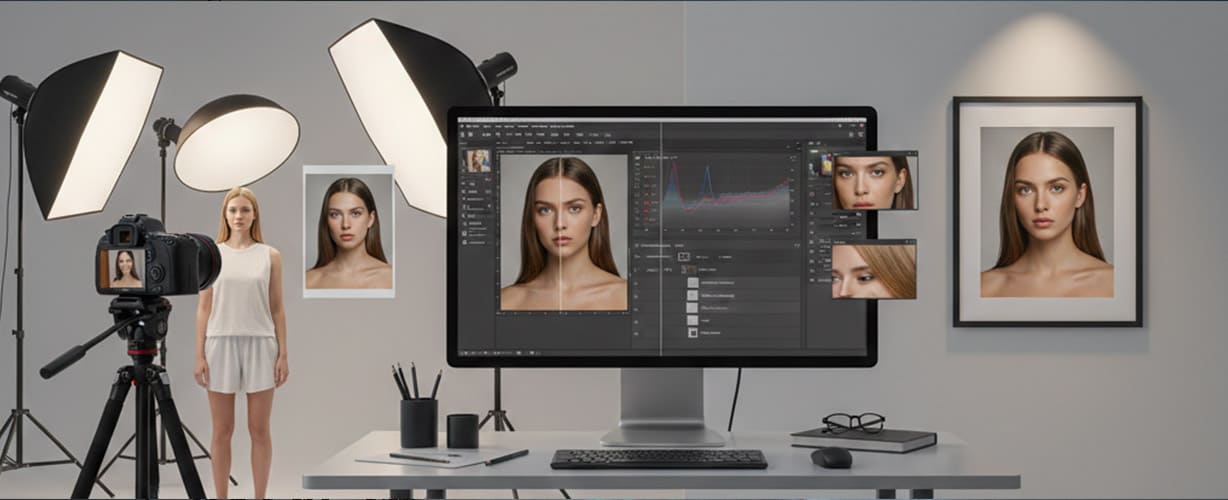
You shoot great photos. But the real job starts when the shutter stops.
Hundreds, maybe thousands, of RAW files drop onto your desk. The clock starts. You must erase backgrounds. Fix the light. Make every product line up perfectly, name every file, resize them all, and deliver a clean gallery.
When clients demand speed and perfection, post-production is the wall you hit. When volume swells, the old way breaks.
The best studios know this. They’ve found a smarter way. They use smart software, secure cloud, and AI image editing to automate the process, cut editing time, and make every image look exactly right.
Here is how they change the game.
Why Traditional Image Pipelines Can’t Scale
The manual grind
Most photography studios still live inside Photoshop or Lightroom. It works fine for small jobs. But a single shoot often ends up with 500 images. Each image needs a dozen edits. Multiply that by weekly delivery cycles, and what looked manageable in Photoshop suddenly becomes a never-ending backlog.
You must manually erase every background. Crop and align every photo. Resize and name every single file. It’s dull work. Every minute wasted here hurts you.
The hidden costs pile up fast:
- Missed deadlines.
- Editors burn out.
- The work looks different from batch to batch.
- You lose clients because you are too slow.
Editing 100 photos is fine. Editing 5,000 photos by hand is impossible.
When volume meets deadlines
Think of the rush:
- A studio needs over 1,000 product shots a week.
- A real estate photographer has hundreds of bracketed shots per house.
- Event photos need to be delivered overnight.
The old answer was always: “Hire more editors”.
But more editors just mean more cost. It doesn’t make a slow process fast.
A modern studio needs a system that scales up without throwing bodies at the problem. SmartPHOTOeditors (SPE) built exactly that: a faster, smarter, and high-volume workflow for today’s demands.
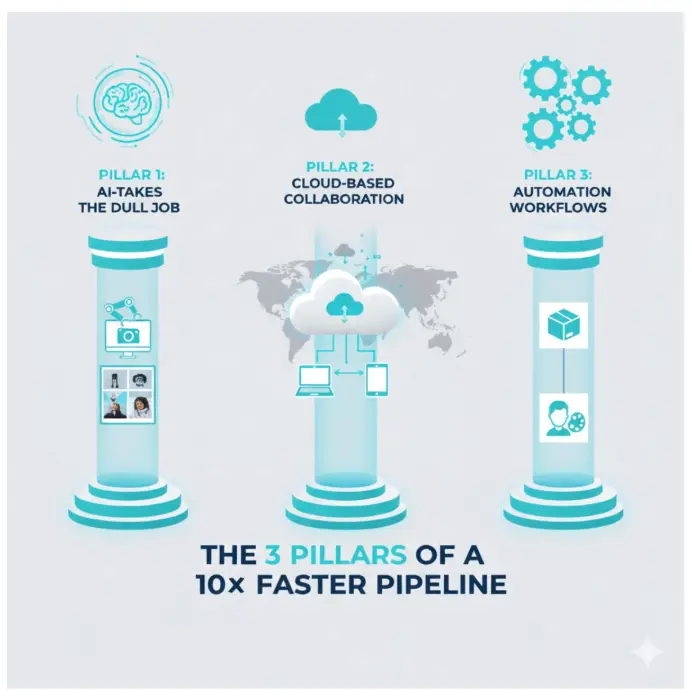
The 3 pillars of a 10× faster pipeline
As per a report by Market.us, the global photo editing software market was valued at USD 1.14 billion in 2024 and is projected to reach USD 1.82 billion by 2034. The leading studios that are scaling successfully aren’t editing faster by clicking faster. They’re changing the system.
Here are the three pillars that lead to 10x faster studio photography editing:
Pillar 1: AI takes over the dull jobs
As per Hustle.co, over 81% of business professionals agree that AI tools help them spend less time on manual tasks, freeing teams to focus on strategic work.
AI’s bulk image processing takes over the tasks that used to steal hours from your day. It removes backgrounds with a click, using the same smart detection models that power SPE’s background removal tools. It crops and aligns products, so every shot looks like it belongs in the same catalog.
AI image editing fixes exposure and color across whole batches, so nothing looks mismatched. Even skin and fabric touch-ups get a first pass through SPE’s AI cleanup, before a retoucher steps in.
All of this means your editors no longer start at zero on each photo. They begin with a clean, consistent base and spend their time on what actually matters: the creative finish. Work speeds up. Quality holds steady. And deadlines stop feeling like emergencies.
Pillar 2: Cloud-based collaboration
When you edit images with AI and cloud-based workflows, the process stops being a headache. Everything lives in one place. No more missing files. No more “final-v7-lastfix.psd.” With a secure cloud system, every image stays organized and visible to the team. You can upload from the studio, your editor can fine-tune from home, and your client can review from anywhere without sending a single zipper file.
SPE sets this up like a real production line. It provides you with AI-driven image workflows for large product catalogs. Images move from upload to AI processing to human review without ever leaving a protected workspace.
With its cloud-based professional photo editing guidelines, your changes can stay synced. Access is controlled. And when a set is approved, you can deliver straight to the client or even into their online store with the right integrations.
It feels smoother because everyone sees the same thing. And nothing gets lost in the shuffle.
Pillar 3: Smart automation workflows
Not every photo should be treated the same. A product shot needs a clean edge and a shadow. A portrait needs gentle retouching and a natural finish. Smart workflows know the difference the moment the files arrive.
You can easily boost product appeal with AI-driven images by leveraging SPE’s hybrid pipeline. Upload a product shoot and the system goes straight to background cleanup, cropping, and quick export. Upload a portrait session, and it handles a basic cleanup first, then passes the images to a human editor for the creative touch. Each type of photo gets exactly what it needs without anyone choosing settings repeatedly.
The best part is consistency. No random crops. No surprise color shifts. Just a reliable flow that keeps brand style locked in, even when thousands of images are moving through the system.
Case study
A wholesale seller of bamboo dinnerware reached out to SPE with a familiar problem. They were scaling their catalog and running out of time. A simple four-image trial quickly became a request for more than a thousand photos; all needed within 48 hours. Source: smartphotoeditors.com/product/case-study-product-image-editing.php
Our faster image pipeline for studios helped them upload the full batch, automate the first round of cleanup and cropping, and then have human editors make sure every image matched in quality. Everything was delivered on schedule, with clean and consistent results and far less cost than a traditional all-manual workflow.
Turnarounds like this are becoming the norm. When volume jumps, a hybrid pipeline is the only way to move fast without losing quality.
Security and Compliance: The Non-Negotiables
Speed and volume are useless if you can’t keep control over sensitive images. Many projects involve images that must stay confidential: unreleased products, model portraits under license, or photos of private interiors. That’s why the foundation of a high-volume workflow must include the right compliance framework.
At SPE, every image passes through a protected cloud workspace. Uploads go directly into secure cloud storage, where access is strictly permission-based so only authorized team members can view or edit. Once edits are done, final exports follow a controlled delivery process in compliance with NDAs and data-retention protocols.
Through this setup, you get to leverage modern AI tools for efficient photo editing and move fast without risking leaks, lost files, or unauthorized access. The result is peace of mind – from upload to the final delivery.
AI + Human Expertise: The Best of Both Worlds
Some steps in AI image editing are similar every time. Things like removing a simple background, centering a product, fixing exposure, clearing small flaws or applying the same color balance across a batch. AI’s automation can take care of those quickly, whether there are ten photos or ten thousand.
Other steps need a human eye. How smooth skin should look. How shadows shape a face. How closely the image matches a brand style. How a product reads when zoomed in. Whether a portrait still feels like a real person. Those choices define personality and trust.
This is where SPE’s hybrid model works best. Our AI image enhancement software handles the routine setup. Editors finish the parts that make the image feel alive. The result is fast delivery, consistent quality and photos that keep their character.
Why Choose SmartPHOTOeditors
While AI handles the heavy lifting, human hands shape the finish. Here is how SmartPHOTOeditors becomes a real production partner, not just a vendor.
Benefit | What it means for you |
|---|---|
| 17 years of editing experience | A proven team you can trust with brand-critical work |
| Large team of portrait and product specialists | Scale instantly during peak seasons without hiring more staff |
| AI-assisted bulk processing | Faster turnaround on large shoots with consistent first-pass quality |
| Clipping path and masking services for precise cutouts | Clean product edges and natural hair detail without manual effort |
| End-to-end Photoshop and retouch services | One partner for simple edits and complex corrections alike |
| Secure enterprise cloud with controlled access | Full protection of unreleased products, private interiors, and portraits |
| Custom pipeline automation and APIs | Editing that plugs directly into your internal tools and storefronts |
| 24/7 production availability | Progress continues even while your studio sleeps |
| Dedicated project management | A single point of contact and smooth workflow from start to finish |
| Adaptable to any photo category | Products, portraits, real estate, jewelry, fashion, and more — all under one roof |
This is not outsourcing. It is a workflow that grows with you.
The Future of Studio Photography Editing
The studios that win tomorrow are the ones that build smarter pipelines today. They will shoot more, deliver faster and stay visually consistent even as volume grows. Human effort will shift toward creativity instead of repetition.
Hybrid AI and cloud workflows are not a prediction anymore. They are already changing how professional production gets done.
If you want to experience a faster, more reliable image pipeline, reach out to SmartPHOTOeditors and see the changes in your photography studio workflow.
FAQs
Does AI editing mean I lose creative control or end up with generic-looking photos?
No. Using AI for image editing does not mean losing creative control. While AI handles cleanup, humans still make every creative decision.
Will AI editing yield consistent results across hundreds or thousands of images?
Yes. Automation keeps everything organized, and editors fix anything that needs a personal touch.
Does using AI or cloud-based pipelines compromise creative control or quality?
The cloud only speeds up access and keeps files safe. The final image quality and creativity stay in human hands.
What are the risks or limitations of relying fully on AI/cloud-automated pipelines?
AI can miss subtle details. A hybrid model avoids this by keeping human judgment in the loop.
SmartPHOTOeditors
 Prev
Prev